

listones

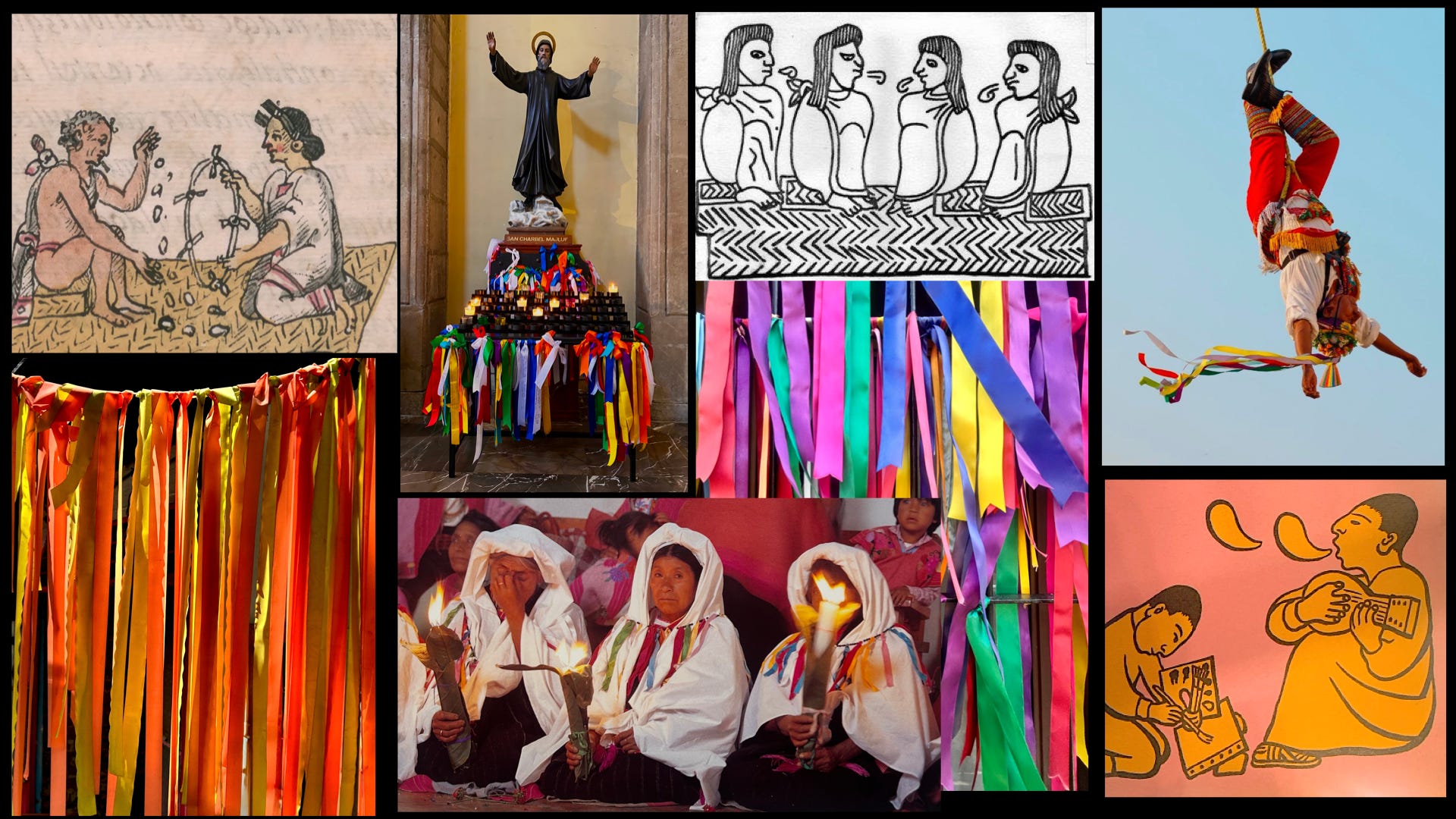
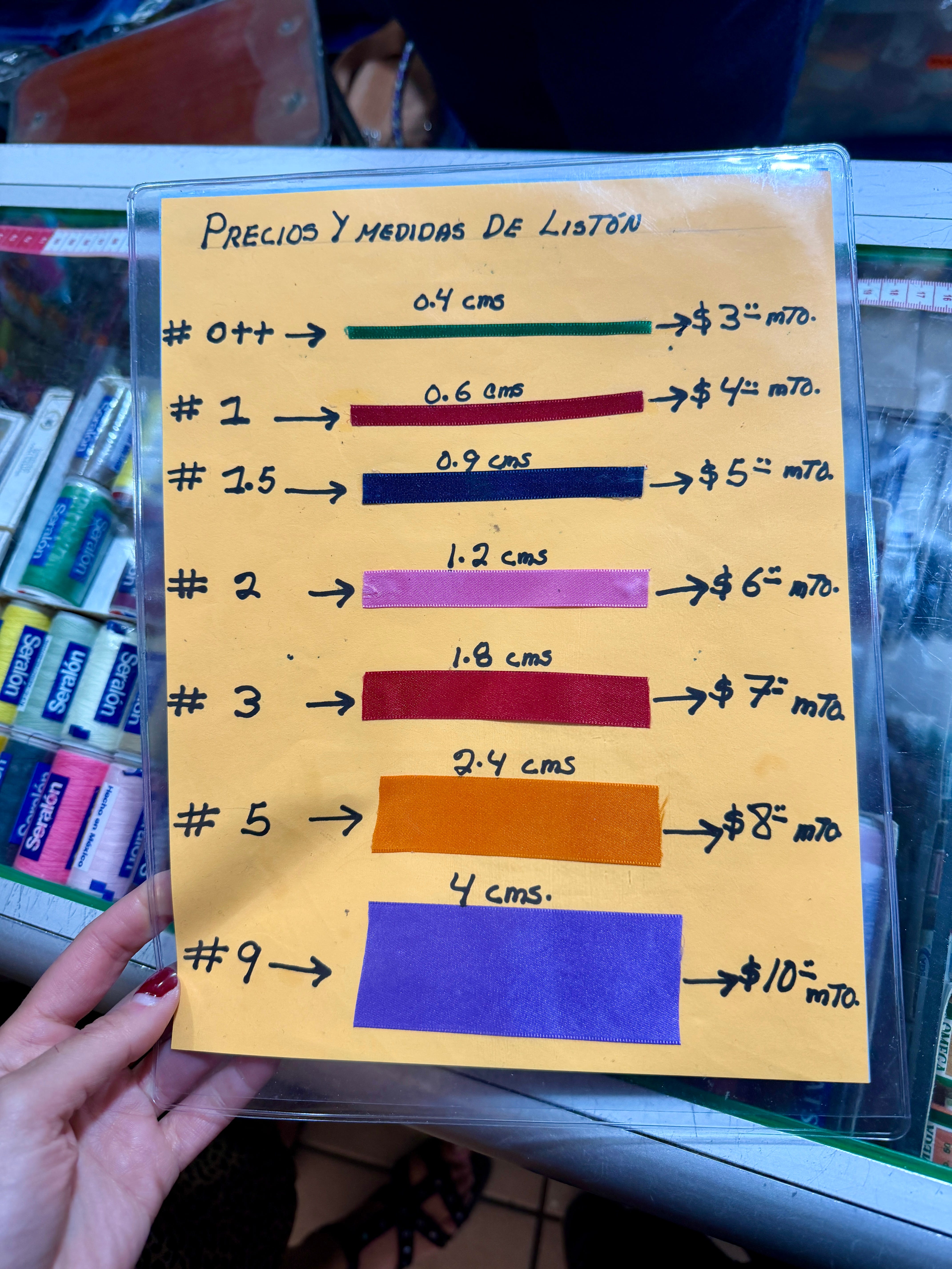
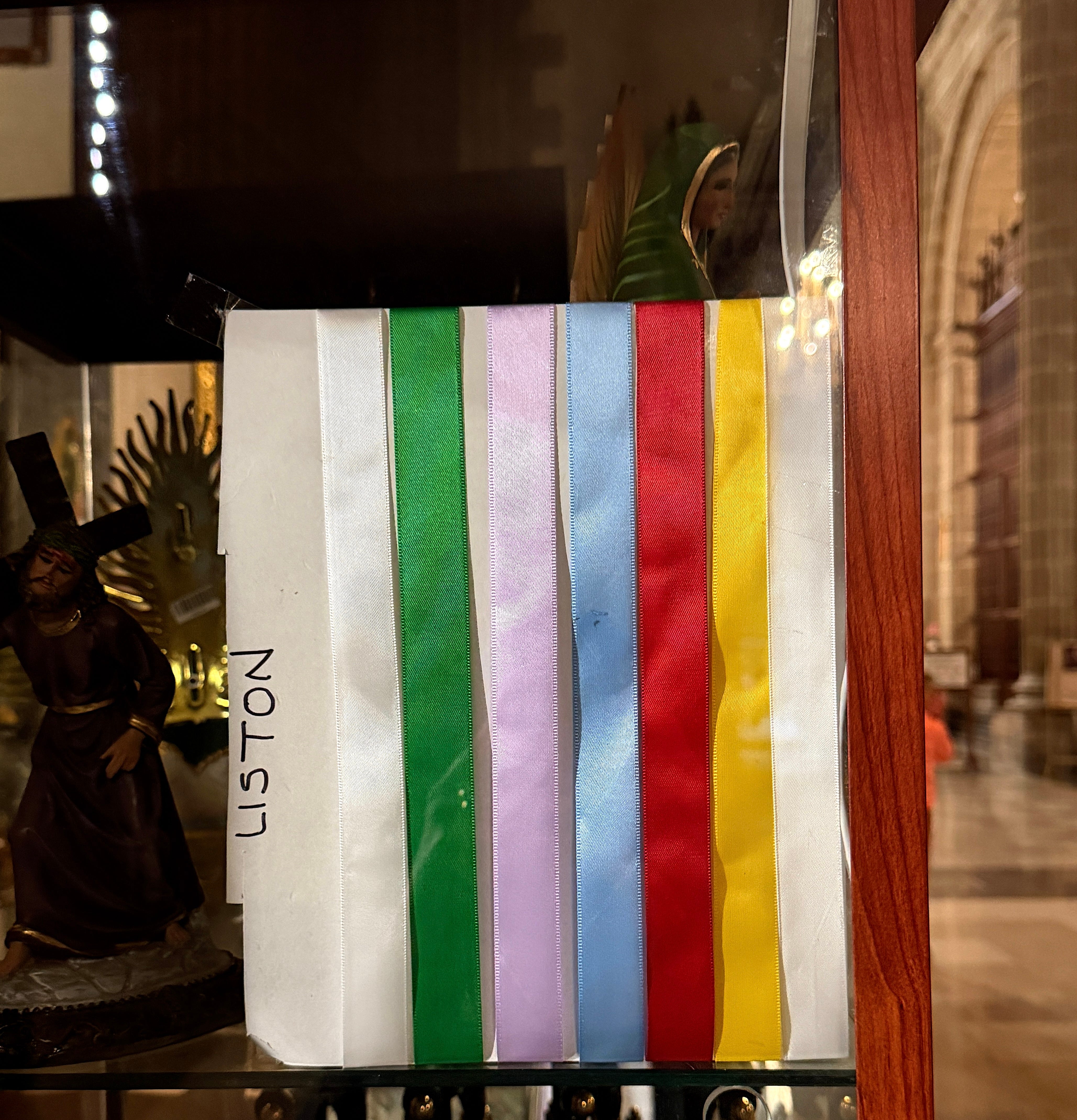
Listones are a boundary; they hold a poetic sense of where something ends and how it unravels. Listón is the Spanish word for ribbon, from the Proto-Germanic listō, meaning “border” or “hem.” Listón preserves structure, an edge that holds the weave intact. The etymology itself contains ritual logic; it binds and borders, marking the in-betweens. Throughout Mexico, they can be found tied to church shrines, window frames, balconies, street lamps, and trees; hung on strings across public spaces; and on the doors of homes in white or black to signify death and mourning.
Each listón is the vestige of a presence: someone was there to arrange them, to write on them, to decorate with them, and to tie them by hand; their body weight anchored as the knots were tied.
I remember seeing them as a child, growing up in Mexico City, mesmerized by their colors, animated by the air as I walked past them. But until recently, these listones were an evanescent memory, only to resurface. These listones speak to me through their colors, their silent billowing, the way they interact with light, and the way they are tied.
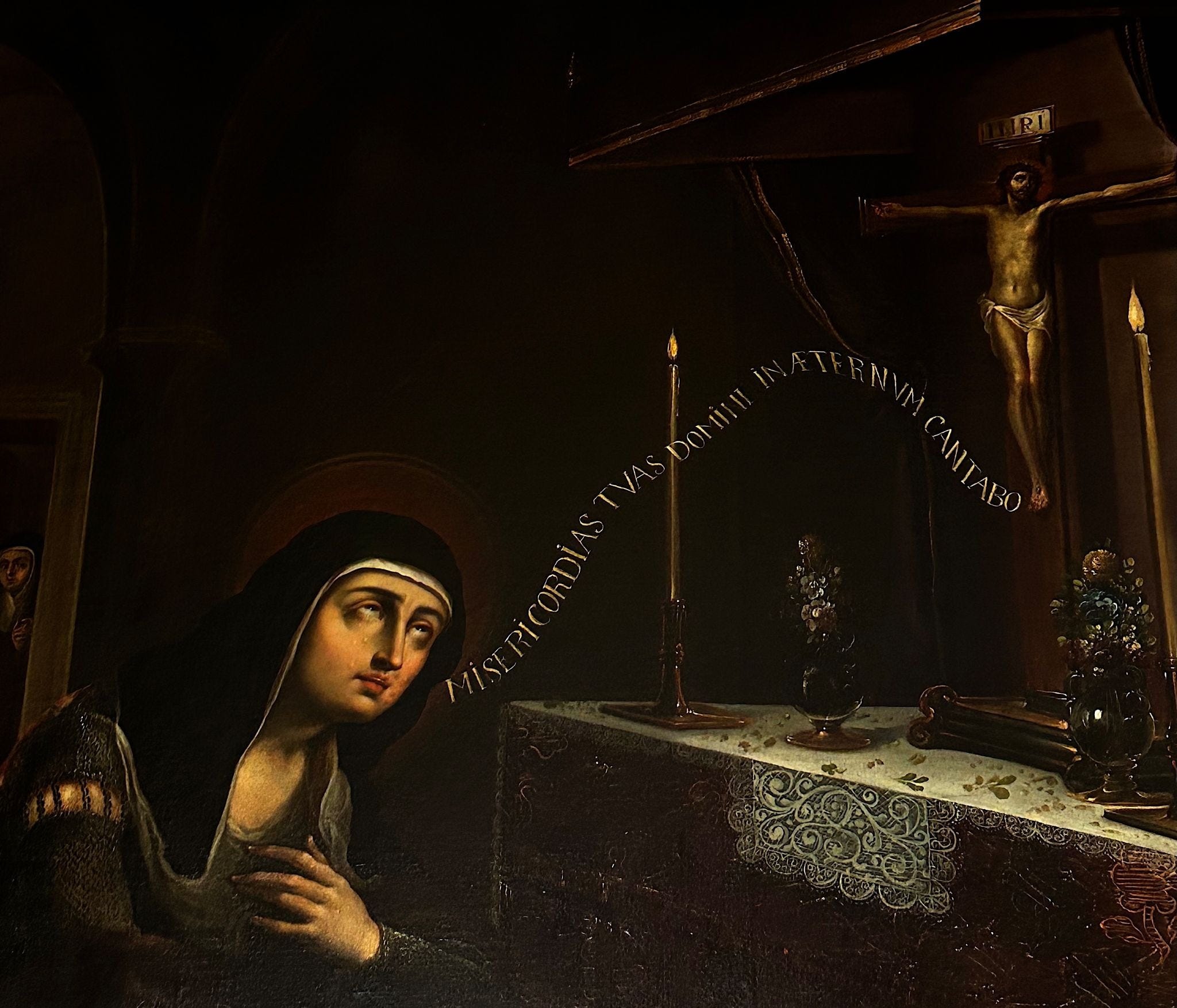
One afternoon, while walking through the cloistered arcades of the 17th-century ex-convent, now the Museo de El Carmen, in San Ángel, Mexico City, the musky halls guided me from room to room, each filled with colonial Mexican and European paintings of saints, monks, and mystics, with words emerging from their mouths in ribbon-like forms. The museum calls these cintas, a word that, when uttered, evokes the sensation of binding, akin to tying a knot. The cintas in these paintings are numinous messages, venous forms wefting from the mouth, breathing words into space, linking the tellurian to the divine.
In art history, speech scrolls appeared independently in both Mesoamerica and Europe. Mesoamerican examples date back as early as 650 BC and persisted into the 16th century after the Spanish conquest, whereas in Europe they emerged in the 13th and 14th centuries. One notable piece at Museo de El Carmen, “Santa Teresa Penitente” by Cristóbal de Villalpando, portrays Saint Teresa of Ávila, a mystic and reformer of the Carmelite order. In the scene, she prays at an altar with a crucifix, tears streaming down her face. At the same time, a ribbon of golden, candlelit text flows from her mouth toward Christ’s feet: Misericordias tuas Domini in æternum cantabo, from one extremity to the other. Saint Teresa’s gaze is transfixed, drawn upward toward the celestial as she breathes out an eternal vow.
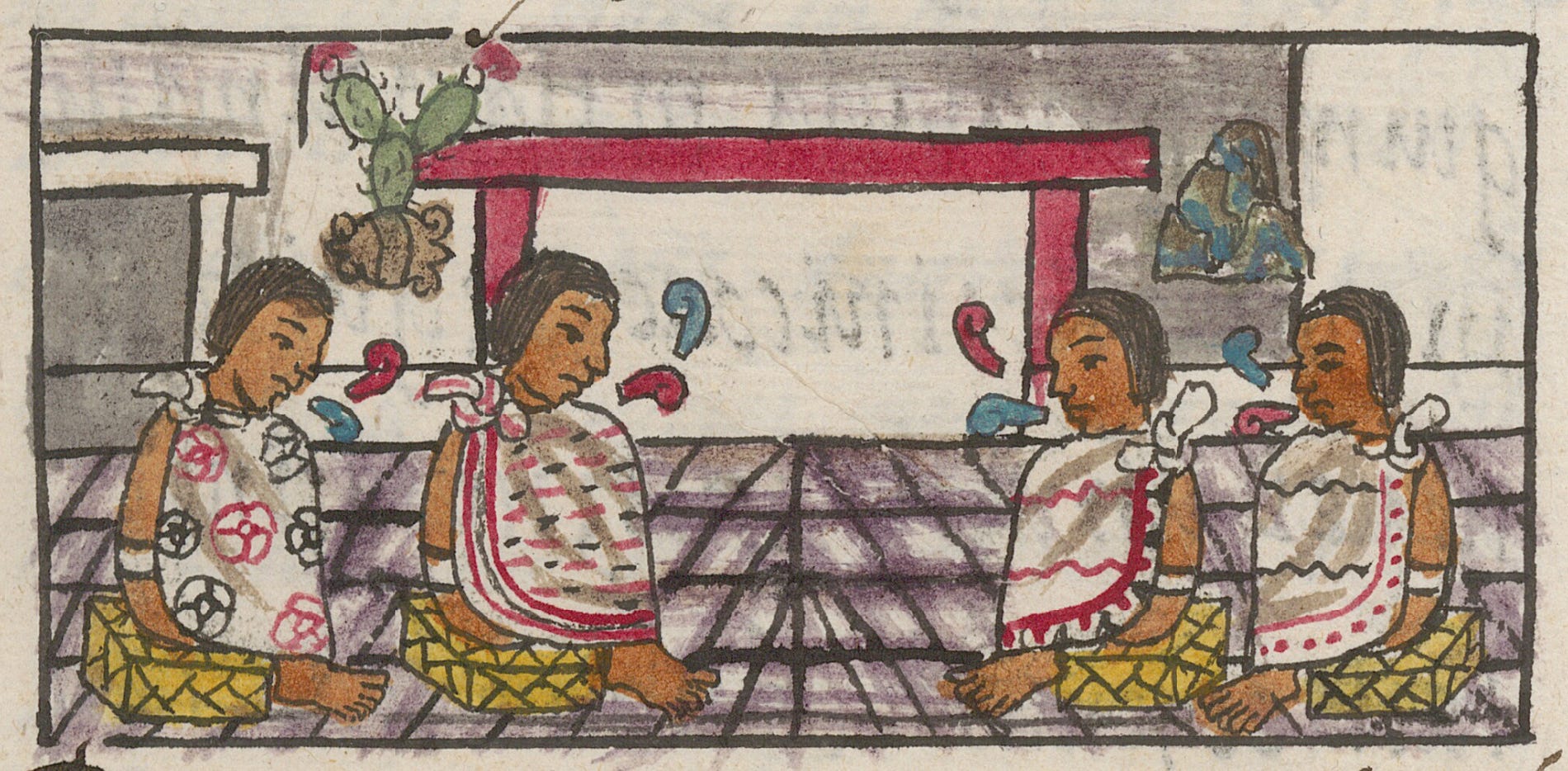
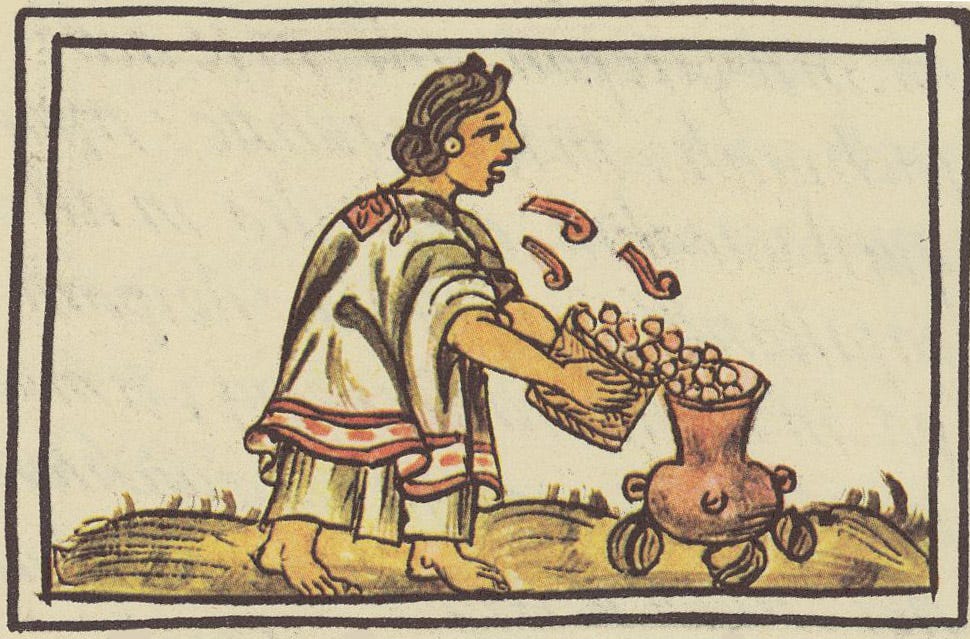
The meandering cintas of holy breath echo the older Mesoamerican volutes (or speech scrolls) seen in paintings and codices. These sinuous glyphs represent the immaterial movement of air, breath, speech, song, chant, and teotl, sacred cosmic energy. In Nahuatl, tlahtolli is the word for speech and language, depicted as curling, ribbon-like scrolls exhaled from the mouth.1 The tlahtolli is materialized breath, the force that animates the ribbon as it emerges from the mouth, just as the decorative listones one passes on the street are animated by the wind and by our physical presence as we walk past them, and just as devotional votive listones are the materialized desires of believers.
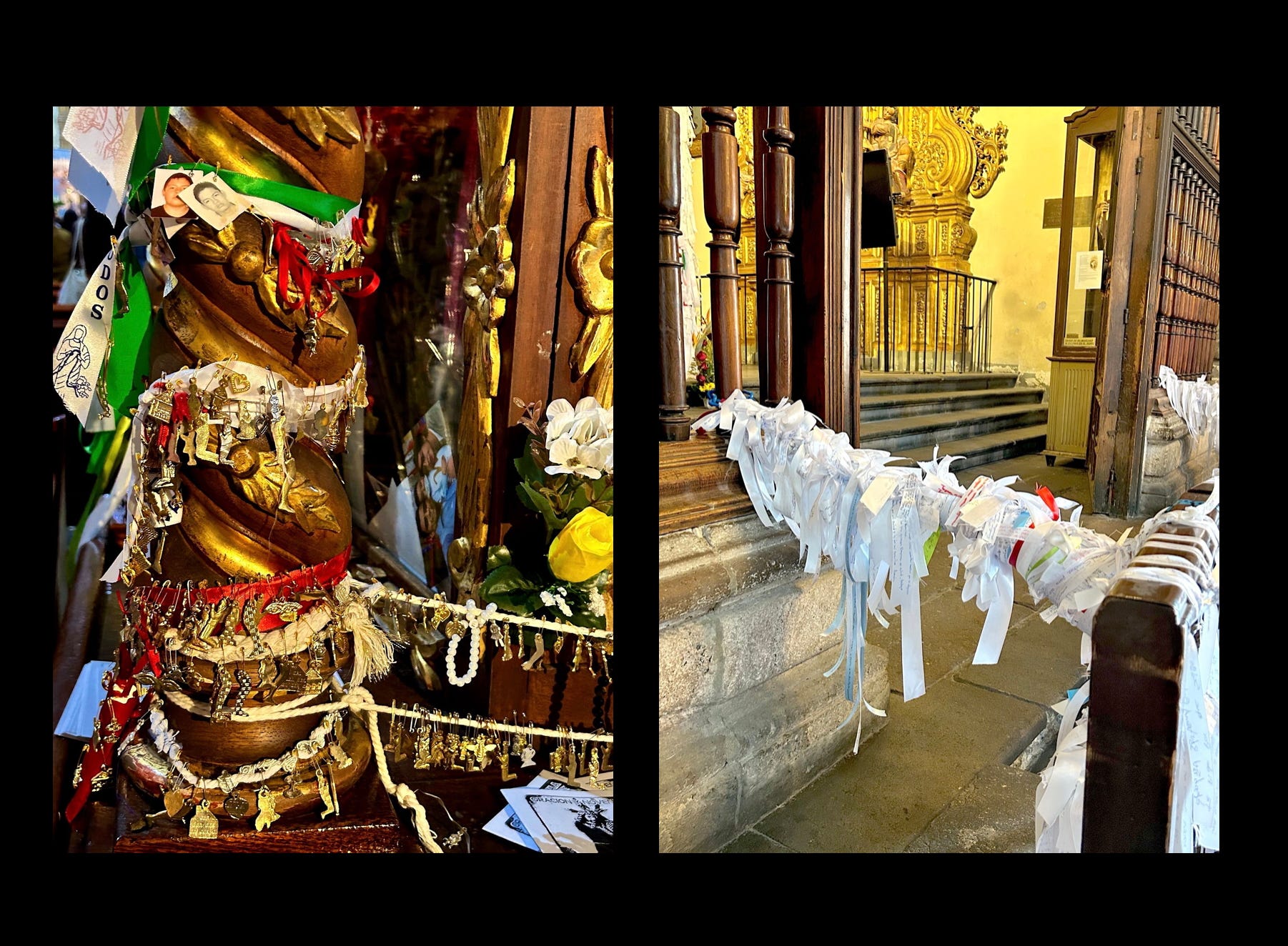
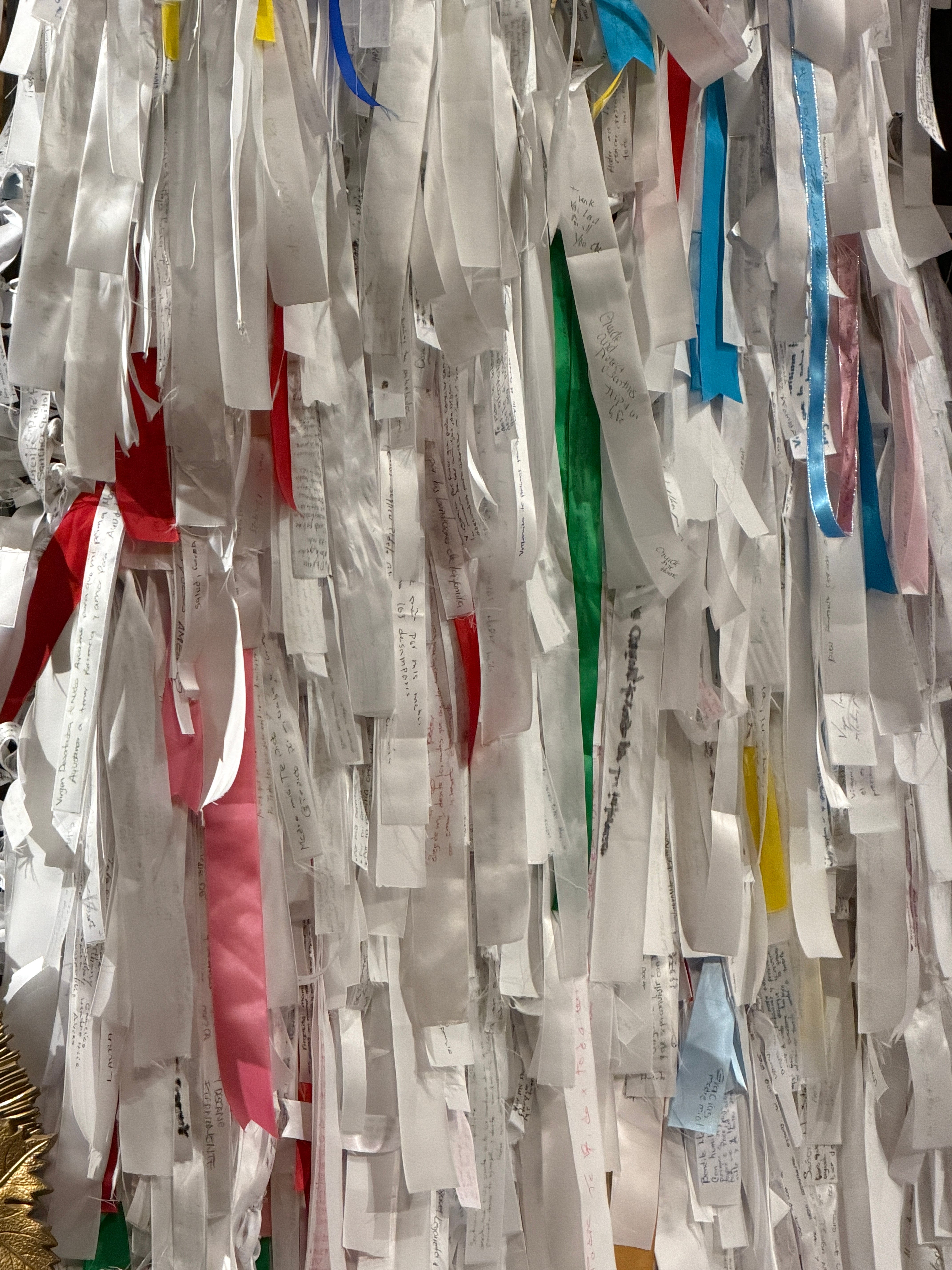
In churches, listones are votive offerings that express vows and prayers. They form a litany of touch: repetitive gestures by hundreds of hands, each day, month, and year, tying listones to shrines. A palimpsest of devotions and invocations written on strips of ribbon. A material channel linking the earthly to the sacred. Some bear only names; others include fully composed vows, prayers, or pleas, and sometimes drawings, such as a house. Sometimes, milagritos are pinned to the listones. Milagritos are small, metal charms used for prayer, healing, and good fortune. They come in various forms, from body parts such as eyes, hearts, and arms to objects such as scissors, locks, and keys, to celestial symbols such as the sun, moon, and stars. Small photos are sometimes pinned to the listones. Whether used in processions or coiled around sacred objects and shrines, listones are a devotional practice that resonates with the word’s original meaning: a segment that defines and sanctifies a boundary.
Listón shrines in Mexico are associated with Saint Charbel (1828–1898), the first Lebanese saint, canonized in 1977. A Lebanese Maronite monk and hermit, he was venerated by Lebanese immigrants who brought his cult to Mexico in the early 20th century. Although Saint Charbel was Lebanese, his popularity grew beyond Lebanese communities, and listones became a unique Mexican tradition not practiced in Lebanon, where worship focuses on Maronite rites and on his tomb in Annaya, Mount Lebanon.
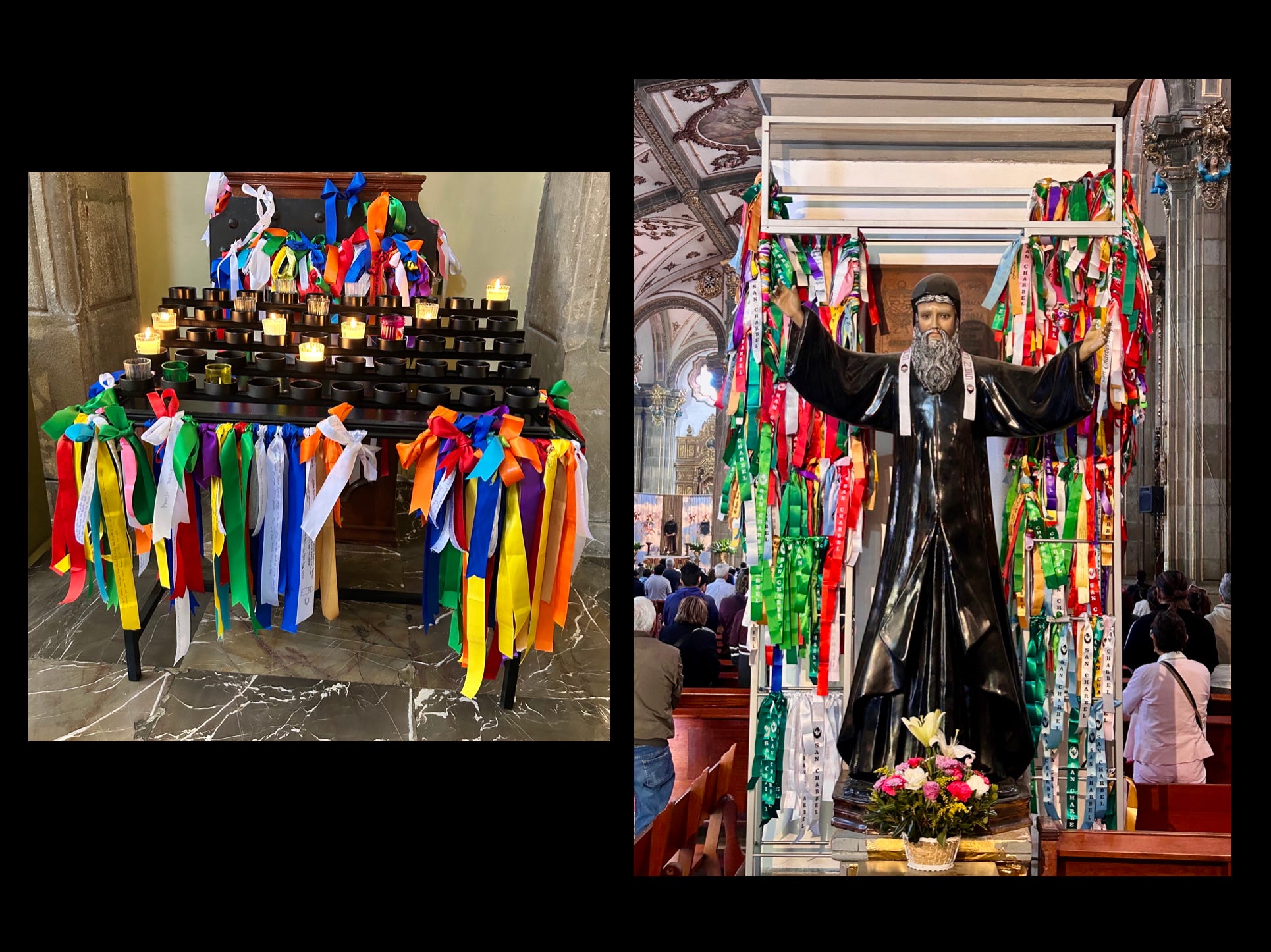
The tying of listones is said to have begun here in Mexico City at the Maronite Cathedral of Mexico and Shrine of St. Charbel (also known as Nuestra Señora de la Balvanera) in the Centro Histórico. A woman went to the cathedral to petition for a miracle. Without paper, she bought a listón, wrote her prayer on it, and tied it to the saint’s wrist so he wouldn’t forget her plea. Her miracle was granted, and she returned to tie more listones in gratitude. The listones have a sensuous quality: densely accumulated, unspoken vows, all piled atop one another as collectively entangled desires. Saint Charbel’s association with physical healing makes the listones all the more earthly.
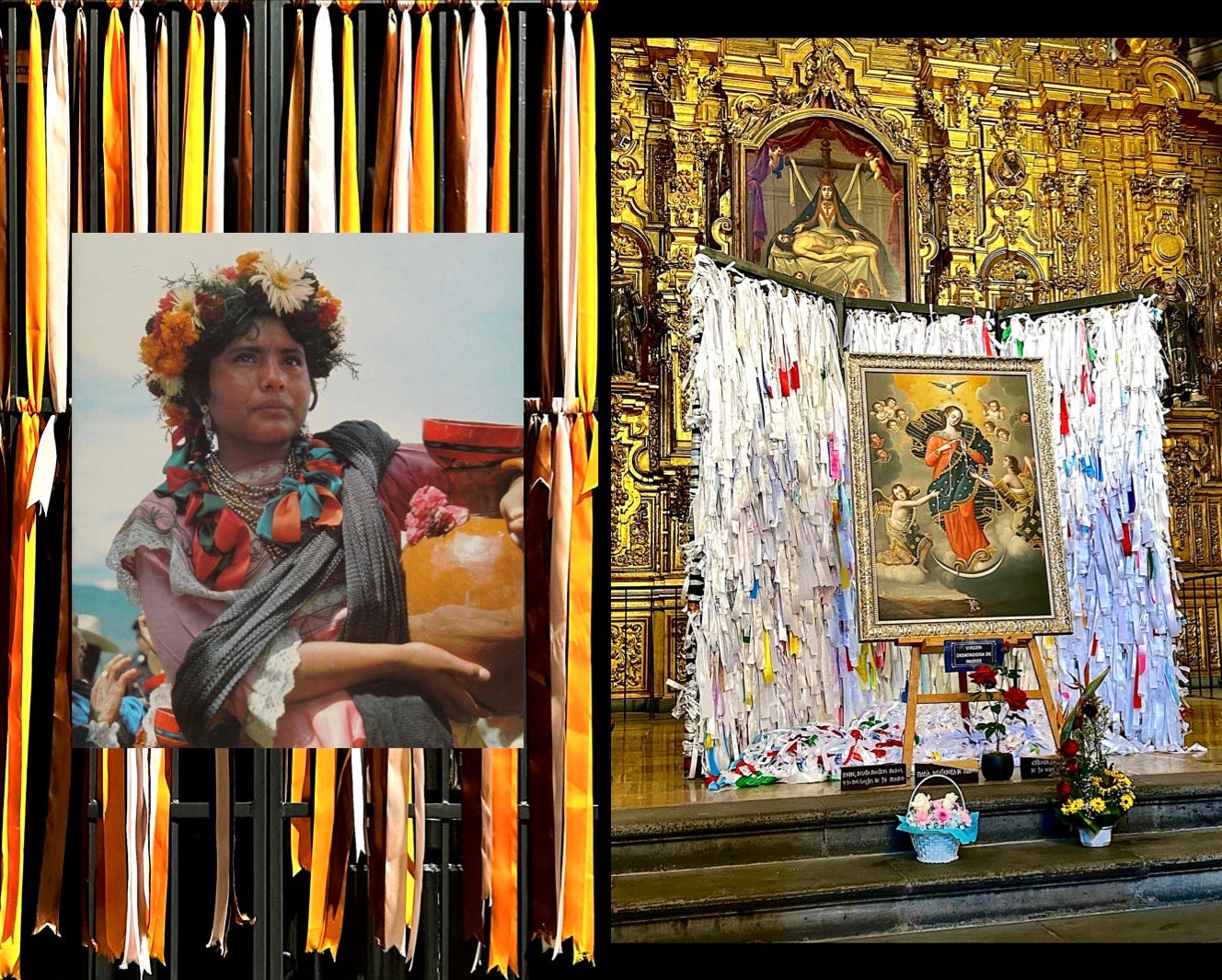
Mary Undoer of Knots (La Virgen Desatanudos) is a German devotion dating to around 1700, centered on a painting by Johann Georg Melchior Schmidtner. The Virgin Mary, surrounded by angels—one giving her knotted ribbons, the other gathering the untied ones—symbolizes life’s challenges as knots she untangles. In Mexico City, shrines are dedicated to her: one at the Metropolitan Cathedral in the Centro Histórico and another at San Juan Bautista in Coyoacán. At the cathedral, a replica of Schmidtner’s painting is displayed on an altar. Behind it is a densely saturated wall of white listones overflowing with vows and prayers.
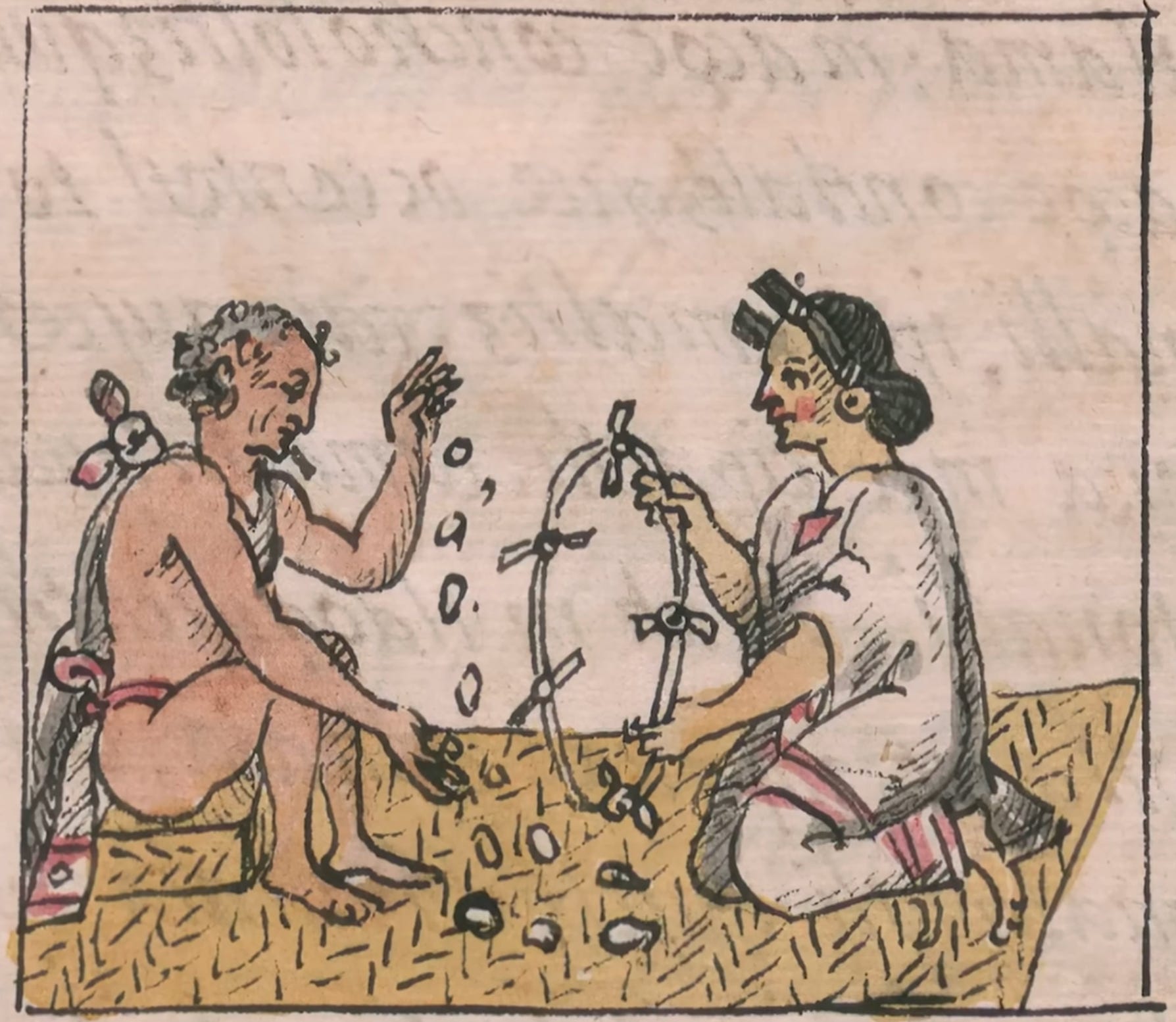
This making and unmaking of knots conjures an image from the 16th-century Florentine Codex by the Spanish Franciscan Bernardino de Sahagún, which depicts Oxomoco and Cipactonal, the goddess and god of the tonalpohualli (the sacred 260-day calendar) and astrology in Mexica (Aztec) mythology, practicing the divinatory arts. They were believed to be the first human couple in creation-and-evolution narratives. Oxomoco holds a circular object with five knots, while Cipactonal tosses corn kernels to help interpret the day signs of fortune and destiny. As Octavio Paz wrote in The Labyrinth of Solitude: "To be born on a certain day was to pertain to a place, a time, a color, and a destiny." As if each differently colored listón were an augur.
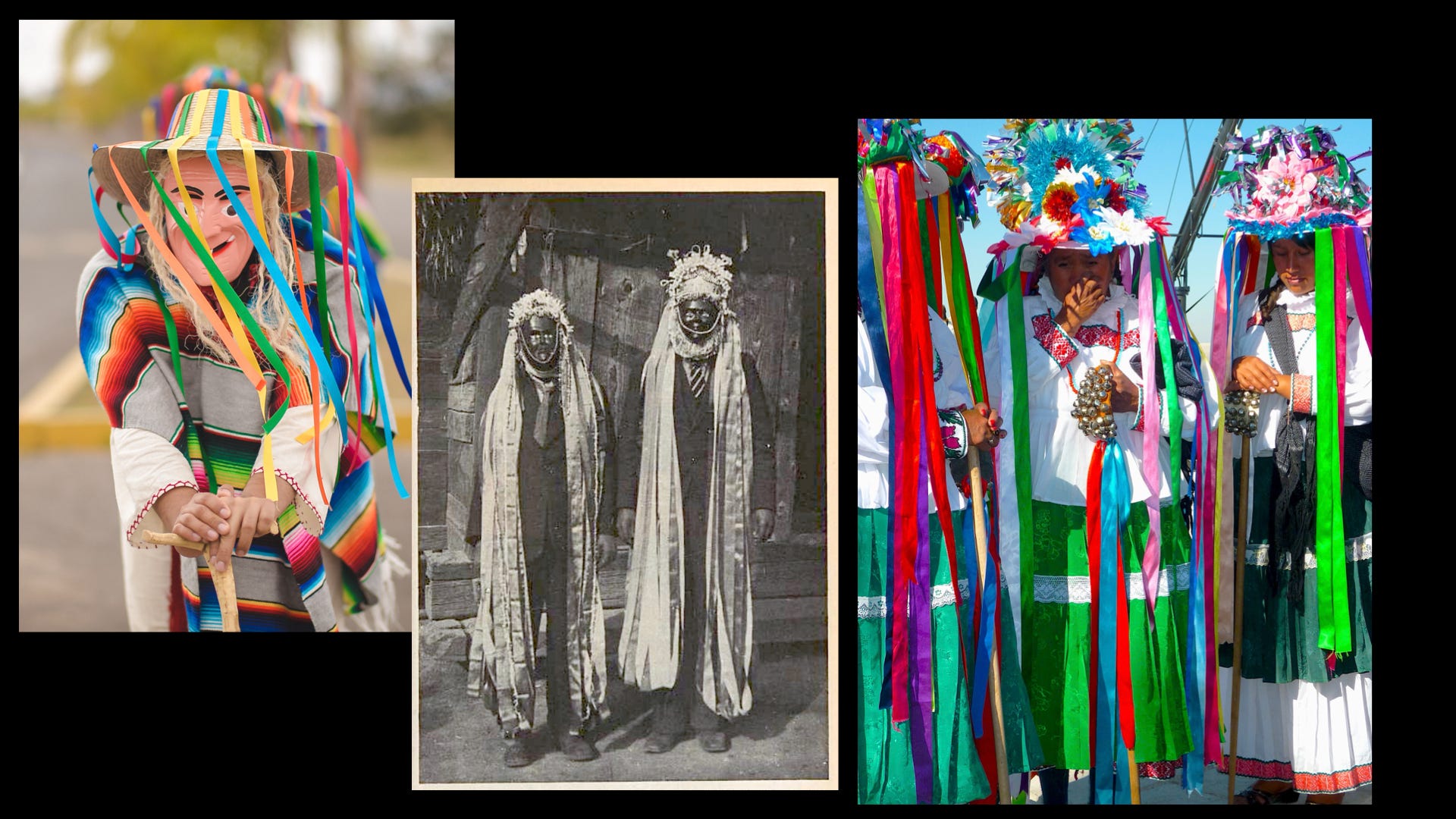
Like the vows written on listones for the shrines of Saint Charbel or Mary Undoer of Knots, folkloric Mexican dance movements, bound in listones, promise through a litany of gestures. In Miguel Covarrubias's essay on pre-Hispanic dance, he references Motolinía, a Franciscan missionary who published a post-conquest account of the history of the Nahua people of central Mexico: "The word for dance or ballet was maceualiztli, from maceua, to dance, to do penance; or netotiliztli, from netolli, vow or promise. Motolinía comments: 'In these festivals and dances, they not only called upon, honored, and praised their gods with songs from their mouths, but also with their hearts and the senses of their bodies. To do this well, they had used many ways, such as in the movements of their heads, arms, and feet, as well as with their whole bodies, to call upon and serve the gods.'”2 Covarrubias concludes that dancing is an ex-voto, or votive offering. The listones are an adornment within the votive practice of dance.
Danza de los Voladores (Dance of the Flyers) is believed to have originated among the Nahua, Otomi, and Huastec peoples of Central Mexico and has since spread to other regions, including the Totonac people of Papantla, Veracruz, with whom the dance is widely associated. The ritual of Danza de los Voladores involves climbing a tall wooden pole. Once at the top, four of the five dancers, tied with ropes around their waists, leap to the ground. The fifth participant remains at the top, dancing with a flute and drum. The voladores’ costume includes “a red, cone-shaped hat adorned with embedded flowers and mirrors. The peak has a fan-like finial with a mirror in the center. From the bottom of the finial, ribbons in the colors of the rainbow, approximately one meter long, hang down the dancer's back."3 As the voladores plunge into the abyss, the listones dance in the air, resembling the Mesoamerican volutes of speech and breath.
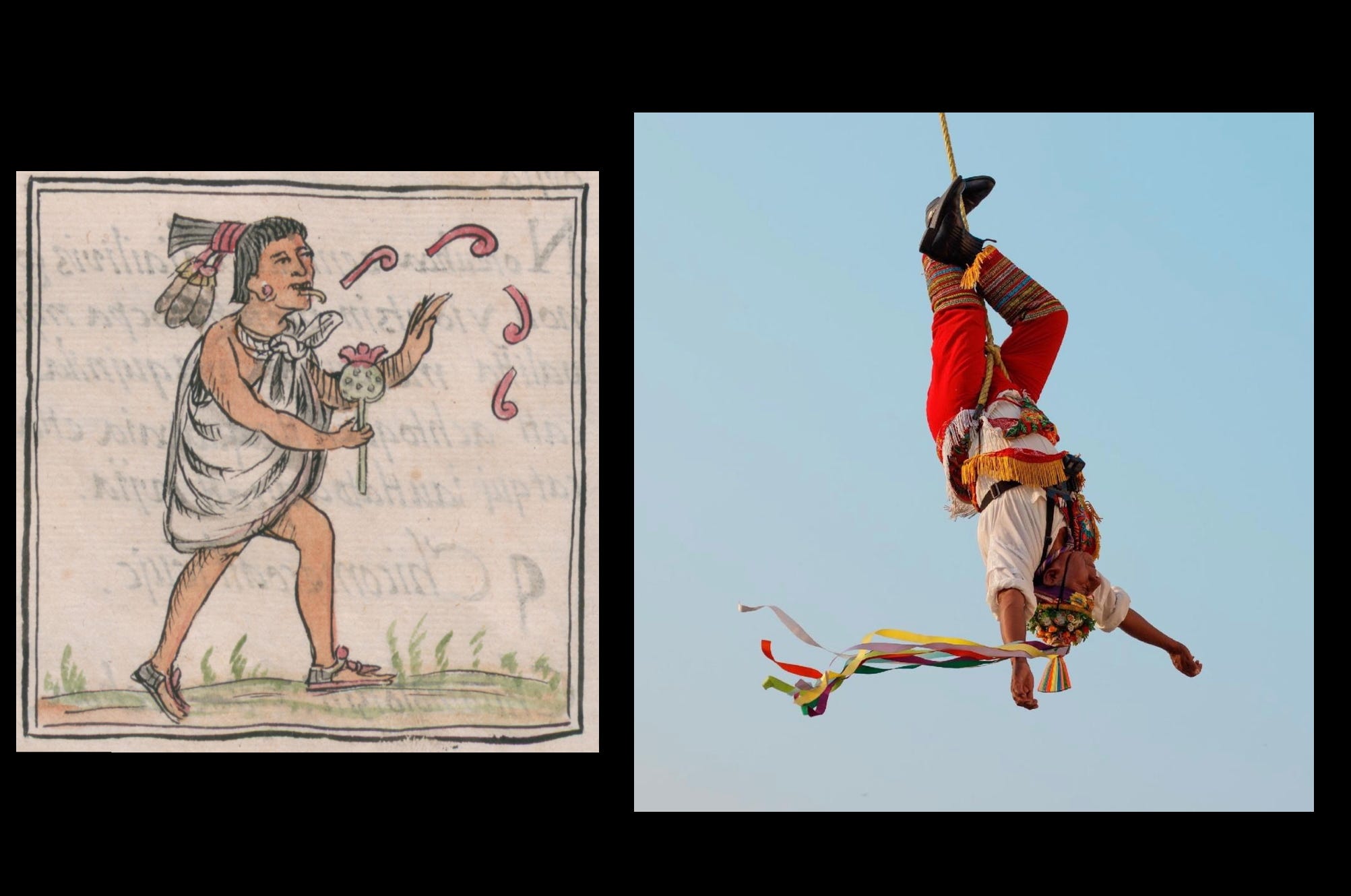
The movement of listones, from public-space decoration to votive prayers to Mesoamerican volutes and colonial cintas, braids through space and time along a path of poetic associations.
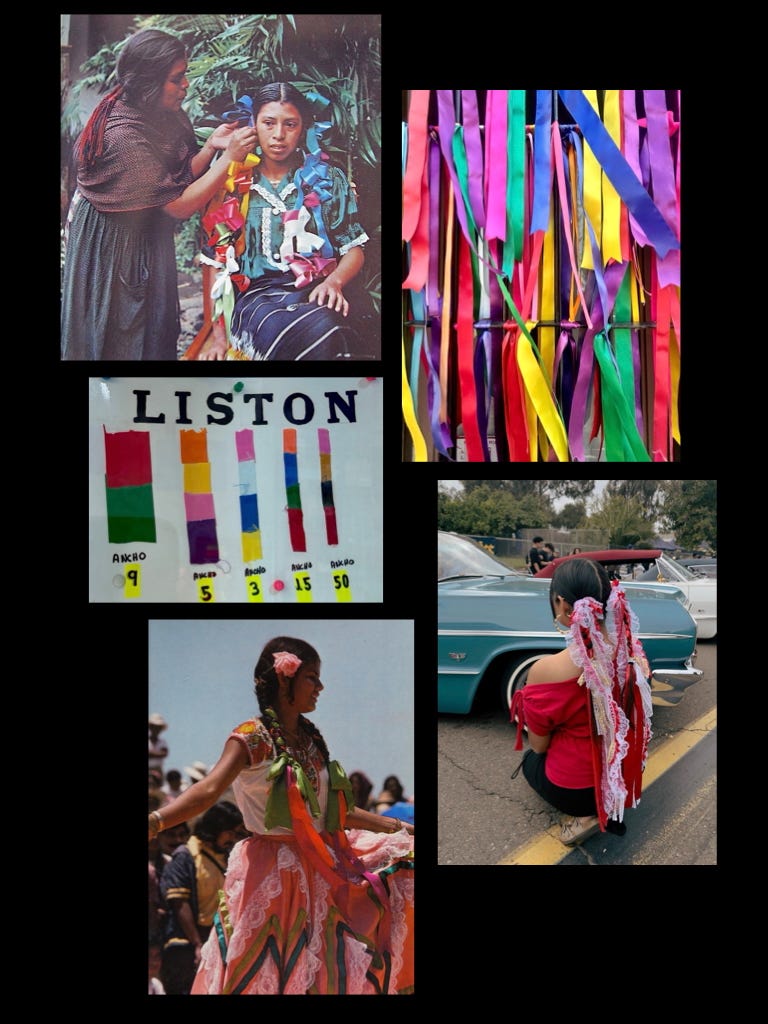
The literal braiding of listones or tying bows in the hair has been a tradition among Indigenous groups for generations, serving practical purposes, such as keeping hair clean and tidy, or, in certain groups, signaling strength and a woman’s status. Braiding listones into the hair is a ritual that connects women across generations within their families and communities. Just as listón petitions are made at shrines by hundreds of hands, so too is the repetitive act of braiding listones into the hair. My grandmother’s mother braided her hair with listones; my grandmother braided my mother’s; my mother braided mine; and I braided my grandmother’s. The practice travels with those who carry it, from life to death. Among the Mexica (Aztecs), fabric defined female identity from birth through death and into the afterlife. The textile-making tools given at birth were burned at death so they could be used in the next life.4
Today, grassroots and cultural movements, such as Ponte Your Moños (Put on Your Bows), co-founded by Dulce Flores and Angie Portillo in Southern California, have emerged in response to immigration raids and heightened deportations in the United States. Their motto reads: “Ponte Your Moños uses braids and bows as symbols of visibility, care, and collective resistance. Braids live in excess of time, touch, memory, and presence.”5
Fabric becomes cosmological, an eternal vow. The personal becomes the end of a long thread of unraveling.


León-Portilla, Miguel. 1983. “Cuícatl y tlahtolli: las formas de expresión en náhuatl.” Estudios de Cultura Náhuatl 16 (septiembre): 13-108.
Miguel Covarrubias, “La Danza Prehispánica,” Arts of Mexico, Year III, nos. 8–9 (Mach–August 1955). https://mna.inah.gob.mx/gabinete_de_lectura_detalle.php?pl=La_danza_prehispanica
T’ajsen Jiménez Ramírez, “Use of Textiles by Indigenous Peoples: The Voladores of Papantla,” Ichan Tecolotl, no. 362 (CIESAS). https://ichan.ciesas.edu.mx/uso-de-textiles-de-los-pueblos-originarios-los-voladores-de-papantla/
Leonardo López Luján and Salvador Guilliem Arroyo, “Mexica Textiles: Archaeological Remains from the Sacred Precincts of Tenochtitlan and Tlatelolco,” PreColumbian Textile Conference VII / Jornadas de Textiles PreColombinos VII, Center for Textile Research, University of Nebraska–Lincoln (October 13, 2017). https://www.mesoweb.com/es/articulos/sub/Textiles.pdf
Ponte Your Moños: https://www.ponteyourmonos.com/